
Elias James Corey
0 sources
Summary
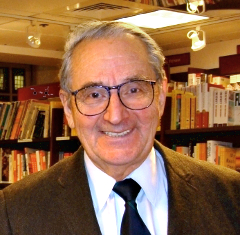
Elias James Corey was born on July 12, 1928[1], in Methuen[2]. He has worked as a chemist[3] and university teacher[4]. He ranks in the top 0.71% of human entities by monthly Wikipedia readership (2,532 views/month, #7,147 of 1,000,298).[5]
Key Facts
- Country of citizenship: United States[6]
- Field of work: chemistry[7]
- Employer: Harvard University[8], University of Illinois Urbana–Champaign[9]
- Doctoral advisor: John C. Sheehan[10]
- Award received: Nobel Prize in Chemistry[11], Willard Gibbs Award[12], ACS Award in Pure Chemistry[13], ACS Award for Creative Work in Synthetic Organic Chemistry,[14], National Medal of Science[15], Wolf Prize in Chemistry[16], NAS Award in Chemical Sciences[17], Priestley Medal[18], Franklin Medal[19], Japan Prize[20], Rosenstiel Award[21], Arthur C. Cope Award[22], honorary doctor of the University of Alicante[23], Dickson Prize in Science[24]
- Member of: Royal Society[25], National Academy of Sciences[26], American Academy of Arts and Sciences[27], American Association for the Advancement of Science[28]
- Influenced by: Dieter Seebach[29]
- Sex or gender: male[30]
- Doctoral student: Dale L. Boger[31], William L. Jorgensen[32], Hisashi Yamamoto[33], Andrew G. Myers[34]
- Commons category: E.J. Corey[35]
- Residence: Cambridge[36]
- Family name: Corey[37]
- Given name: Elias[38], James[39]
- Topic's main category: Category:E.J. Corey[40]
Body
Works and Contributions
Things named for Elias James Corey include Johnson–Corey–Chaykovsky reaction[41], Corey–Fuchs reaction[42], Corey–Itsuno reduction[43], Corey–House synthesis[44], Corey–Kim oxidation[45], Corey-Seebach reaction[46], Corey–Winter olefin synthesis[47], and Corey-Nicolaou macrolactonization[48].
Why It Matters
Elias James Corey has Wikipedia articles in 27 language editions, a strong signal of global cultural recognition.[49] He is known by 21 alternative names across languages and contexts.[50]
He has been cited as an influence by Ryōji Noyori[51], a chemist[52], b. 1938[53], of Japan[54], awarded the Order of Culture[55], specialised in chemistry[56].
Entities named for him include Johnson–Corey–Chaykovsky reaction[41], Corey–Fuchs reaction[42], Corey–Itsuno reduction[43], Corey–House synthesis[44], Corey–Kim oxidation[45], and Corey-Seebach reaction[46].
His notable doctoral advisees include Hisashi Yamamoto[57], a chemist[58], b. 1943[59], of Japan[60], awarded the ACS Award for Creative Work in Synthetic Organic Chemistry,[61], specialised in chemistry[62]; William L. Jorgensen[63], a chemist[64], b. 1949[65], of United States[66], awarded the Sterling Professor[67], specialised in computational chemistry[68]; and Dale L. Boger[69], a chemist[70], b. 1953[71], of United States[72], awarded the Ernest Guenther Award[73], specialised in organic chemistry[74].
FAQs
Where was Elias James Corey born?
Elias James Corey's place of birth was Methuen[2].
What did Elias James Corey do for work?
Elias James Corey worked as a chemist[3] and university teacher[4].
What awards did Elias James Corey receive?
Honors received include Nobel Prize in Chemistry[11], Willard Gibbs Award[12], ACS Award in Pure Chemistry[13], and ACS Award for Creative Work in Synthetic Organic Chemistry,[14].
Who did Elias James Corey influence?
Elias James Corey has been cited as an influence by Ryōji Noyori[51].