
Dead Souls
1842 novel by Nikolai Gogol
Press Enter · cited answer in seconds
0 sources
Dead Souls
Summary
Dead Souls is a literary work[1]. It has Wikipedia articles in 26 language editions, a strong signal of global cultural recognition.[2]
Key Facts
- Dead Souls authored Nikolai Gogol[3].
- Dead Souls's instance of is recorded as literary work[4].
- Dead Souls's genre is satirical fiction[5].
- Dead Souls's genre is picaresque novel[6].
- Dead Souls's depicts is recorded as soul[7].
- Dead Souls's depicts is recorded as serfdom[8].
- Dead Souls's Commons category is recorded as Dead Souls[9].
- Dead Souls's language of work or name is recorded as Russian[10].
- Dead Souls's country of origin is recorded as Russian Empire[11].
- Dead Souls comprises Q117318976[12].
- Dead Souls comprises Q117319018[13].
- 1835 marks the founding of Dead Souls[14].
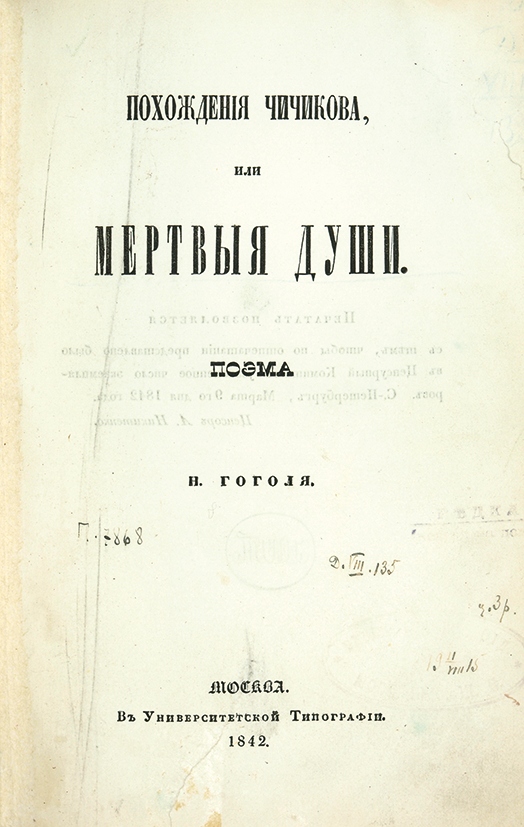
- Dead Souls was released on 1842[15].
- Dead Souls's translator is recorded as Zygmunt Kierdej[16].
- Dead Souls's characters is recorded as Plyushkin[17].
- Dead Souls's characters is recorded as Sobakevich[18].
- Dead Souls's characters is recorded as Pavel Ivanovich Chichikov[19].
- Dead Souls's has edition or translation is recorded as Q98769234[20].
- Dead Souls's has edition or translation is recorded as Dead Souls[21].
- Dead Souls's has edition or translation is recorded as Q99194531[22].
- Dead Souls's has edition or translation is recorded as Q99689232[23].
- Dead Souls's has edition or translation is recorded as Q99689701[24].
- Dead Souls's has edition or translation is recorded as Dead Souls—A Poem[25].
- Dead Souls's has edition or translation is recorded as Q117319032[26].
- Dead Souls's has edition or translation is recorded as Q138507483[27].
Body
Authorship and Creation
Dead Souls authored Nikolai Gogol[3].
Publication
Dead Souls was released on 1842[15]. Its language of work or name is recorded as Russian[10]. Genres include satirical fiction[5] and picaresque novel[6].
Why It Matters
Dead Souls has Wikipedia articles in 26 language editions, a strong signal of global cultural recognition.[2] It is known by 7 alternative names across languages and contexts.[28]