
Cross of Gold speech
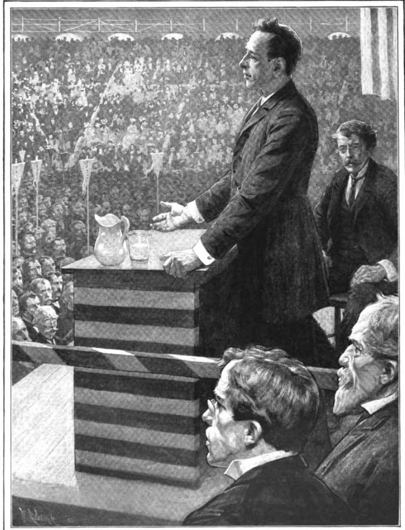
0 sources
Summary
Cross of Gold speech is an oration[1]. It ranks in the top 6% of oration entities by monthly Wikipedia readership (882 views/month).[2]
Key Facts
- Cross of Gold speech is in the country of United States[3].
- Cross of Gold speech's instance of is recorded as oration[4].
- Cross of Gold speech took place at Chicago Coliseum[5].
- Cross of Gold speech is part of 1896 Democratic National Convention[6].
- Cross of Gold speech's Commons category is recorded as Cross of Gold speech[7].
- Cross of Gold speech's language of work or name is recorded as English[8].
- Cross of Gold speech occurred on July 9, 1896[9].
- Cross of Gold speech's organizer is recorded as Democratic Party[10].
- Cross of Gold speech's speaker is recorded as William Jennings Bryan[11].
- Cross of Gold speech's official website is recorded as http://historymatters.gmu.edu/d/5354/[12].
- Cross of Gold speech's main subject is bimetallism[13].
- Cross of Gold speech's main subject is free silver[14].
- Cross of Gold speech's last line is recorded as {'lang': 'en', 'text': 'You shall not press down upon the brow of labor this crown of thorns; you shall not crucify mankind upon a cross of gold.'}[15].
Product Details
The following facts are restated verbatim from public-domain and CC0 open-data sources — every line is independently verifiable against the named source's catalog.
MusicBrainz — CC0 open music encyclopedia
- MusicBrainz ID: 577efee5-b148-4b16-acaa-f1373ff70fa3[16]
Body
When and Where
Cross of Gold speech took place on July 9, 1896[9]. The location of it was Chicago Coliseum[5]. It is in the country of United States[3].
Context
Cross of Gold speech is part of 1896 Democratic National Convention[6]. Its instance of is recorded as oration[4].
Outcome and Impact
Cross of Gold speech's speaker is recorded as William Jennings Bryan[11].
Why It Matters
Cross of Gold speech ranks in the top 6% of oration entities by monthly Wikipedia readership (882 views/month).[2] It has Wikipedia articles in 7 language editions, a strong signal of global cultural recognition.[17] It is known by 4 alternative names across languages and contexts.[18]