
Constantine Chernenko
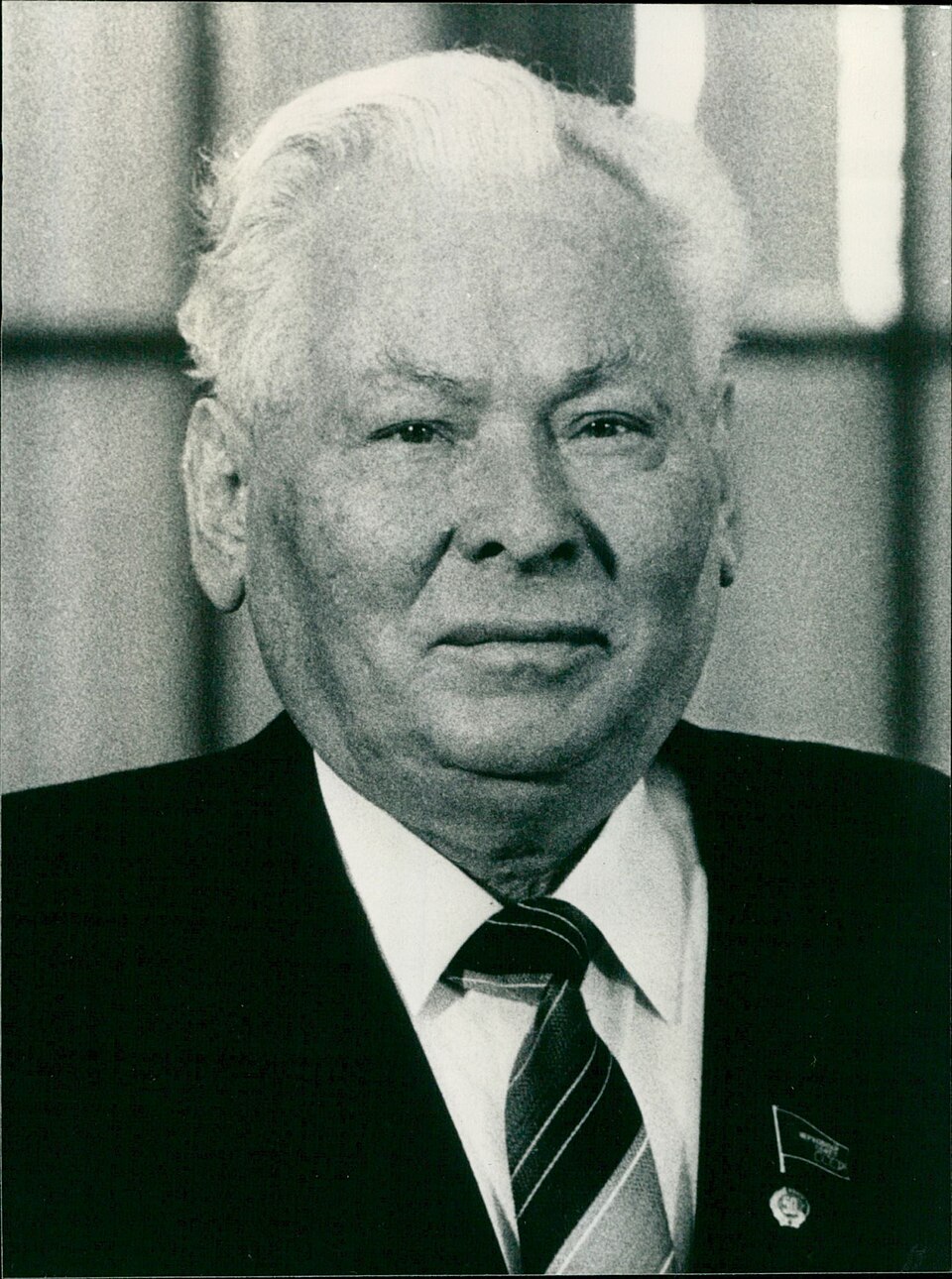
0 sources
Constantine Chernenko
Summary
Constantine Chernenko is a human[1]. He was born in Bolshaya Tes[2]. He was born on September 11, 1911[3]. He died in Moscow[4]. He died on March 10, 1985[5]. He worked as a politician[6]. He has Wikipedia articles in 29 language editions, a strong signal of global cultural recognition.[7]
Key Facts
- Constantine Chernenko's place of birth was Bolshaya Tes[2].
- Constantine Chernenko passed away in Moscow[4].
- Constantine Chernenko was born on September 11, 1911[3].
- Constantine Chernenko died on March 10, 1985[5].
- Constantine Chernenko is buried at Kremlin Wall Necropolis[8].
- Among Constantine Chernenko's spouses was Anna Chernenko[9].
- A child of Constantine Chernenko was Albert Chernenko[10].
- Constantine Chernenko held citizenship in Soviet Union[11].
- Constantine Chernenko is identified as part of the Ukrainians ethnic group[12].
- Constantine Chernenko worked as a politician[6].
- Constantine Chernenko held the position of General Secretary of the Communist Party of the Soviet Union[13].
- Constantine Chernenko held the position of Chairman of the Presidium of the Supreme Soviet of the Soviet Union[14].
- Constantine Chernenko held the position of Member of the Politburo of the CPSU Central Committee[15].
- Constantine Chernenko held the position of Candidate member of the Politburo of the CPSU Central Committee[16].
- Constantine Chernenko held the position of Secretary of the Communist Party of the Soviet Union[17].
- Constantine Chernenko was educated at Ion Creangă Pedagogical State University[18].
- Constantine Chernenko's education included a stint at Higher Party School at the Central Committee of the CPSU[19].
- Constantine Chernenko received the USSR State Prize[20].
- Constantine Chernenko received the Order of Lenin[21].
- Constantine Chernenko received the Hero of Socialist Labour[22].
- Constantine Chernenko received the Order of Karl Marx[23].
- Constantine Chernenko received the Order of Klement Gottwald[24].
- Constantine Chernenko received the Order of the Red Banner of Labour[25].
- Constantine Chernenko was a member of Politburo of the Central Committee of the Communist Party of the Soviet Union[26].
- Constantine Chernenko's religion is recorded as atheism[27].
Body
Origins and Family
Constantine Chernenko was born in Bolshaya Tes[2]. He was born on September 11, 1911[3]. He is identified as part of the Ukrainians ethnic group[12].
Education
Educated at Ion Creangă Pedagogical State University[18], a university[28], in Moldova[29], founded in 1940[30] and Higher Party School at the Central Committee of the CPSU[19], a higher party school[31], in Soviet Union[32], founded in 1938[33], headquartered in Moscow[34].
Career and Affiliations
Constantine Chernenko's professions included politician[6]. Positions held include General Secretary of the Communist Party of the Soviet Union[13], a historical position[35], in Soviet Union[36], founded in 1922[37]; Chairman of the Presidium of the Supreme Soviet of the Soviet Union[14], a head of state[38], in Soviet Union[39], founded in 1936[40]; Member of the Politburo of the CPSU Central Committee[15], a historical position[41], in Soviet Union[42], founded in 1917[43]; Candidate member of the Politburo of the CPSU Central Committee[16], a position[44], in Soviet Union[45], founded in 1919[46]; and Secretary of the Communist Party of the Soviet Union[17].
Recognition
Awards received include USSR State Prize[20], a Soviet state award[47], in Soviet Union[48], founded in 1966[49]; Order of Lenin[21], an order[50], in Soviet Union[51], founded in 1930[52]; Hero of Socialist Labour[22], a title of honor[53], in Soviet Union[54], founded in 1938[55]; Order of Karl Marx[23], an order[56], in German Democratic Republic[57], founded in 1953[58]; Order of Klement Gottwald[24], an order[59], in Czechoslovakia[60], founded in 1953[61]; and Order of the Red Banner of Labour[25], a socialist order of merit[62], in Soviet Union[63], founded in 1928[64].
Personal Life
Constantine Chernenko was married to Anna Chernenko[9]. A child of him was Albert Chernenko[10]. His religion is recorded as atheism[27]. He was affiliated with the Communist Party of the Soviet Union[65].
Death and Burial
Constantine Chernenko died on March 10, 1985[5]. He passed away in Moscow[4]. Recorded cause of death include pulmonary emphysema[66] and cardiac arrest[67]. Burial took place at Kremlin Wall Necropolis[8].
Works and Contributions
Things named for Constantine Chernenko include Șoldănești[68], a city[69], in Moldova[70] and Sharypovo[71], a city or town[72], in Russia[73], founded in 1701[74].
Why It Matters
Constantine Chernenko has Wikipedia articles in 29 language editions, a strong signal of global cultural recognition.[7] He is known by 70 alternative names across languages and contexts.[75]
Entities named for him include Șoldănești[68], a city[69], in Moldova[70] and Sharypovo[71], a city or town[72], in Russia[73], founded in 1701[74].
FAQs
Where was Constantine Chernenko born?
Constantine Chernenko was born in Bolshaya Tes[2].
Where did Constantine Chernenko die?
Constantine Chernenko died in Moscow[4].
Who was Constantine Chernenko married to?
Constantine Chernenko's spouses include Anna Chernenko[9].
What did Constantine Chernenko do for work?
Constantine Chernenko worked as politician[6].
Where did Constantine Chernenko go to school?
Constantine Chernenko was educated at Ion Creangă Pedagogical State University[18] and Higher Party School at the Central Committee of the CPSU[19].
What awards did Constantine Chernenko receive?
Honors received include USSR State Prize[20], Order of Lenin[21], Hero of Socialist Labour[22], and Order of Karl Marx[23].