
Cinna
tragedy by Pierre Corneille written for the Théâtre du Marais in 1639
Press Enter · cited answer in seconds
0 sources
Cinna
Summary
Cinna is a literary work[1]. Cinna ranks in the top 4% of literary_work entities by monthly Wikipedia readership (28 views/month).[2]
Key Facts
- Cinna authored Pierre Corneille[3].
- Cinna's instance of is recorded as literary work[4].
- Cinna is associated with the Classicism movement[5].
- Cinna's genre is historical fiction[6].
- Cinna's genre is tragedy[7].
- Cinna's Commons category is recorded as Cinna (Corneille)[8].
- Cinna's language of work or name is recorded as French[9].
- Cinna's country of origin is recorded as France[10].
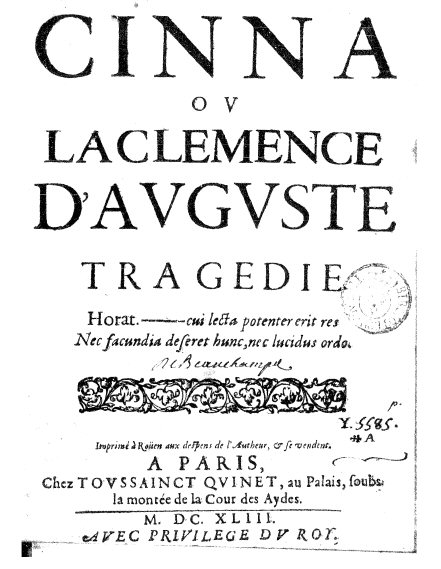
- Cinna was published on 1643[11].
- Cinna's has edition or translation is recorded as Q114210423[12].
- Cinna's narrative location is recorded as Rome[13].
- Cinna's main subject is Gnaeus Cornelius Cinna Magnus[14].
- Cinna's date of first performance is recorded as 1641[15].
- Cinna's described by source is recorded as New International Encyclopedia[16].
- Cinna's described by source is recorded as Meyers Konversations-Lexikon, 4th edition (1885–1890)[17].
- Cinna's title is recorded as {'lang': 'fr', 'text': "Cinna ou la Clémence d'Auguste"}[18].
- Cinna's short name is recorded as {'lang': 'fr', 'text': 'Cinna'}[19].
- Cinna's different from is recorded as Cinna[20].
- Cinna's form of creative work is recorded as play[21].
Body
Authorship and Creation
Cinna authored Pierre Corneille[3].
Publication
Cinna was released on 1643[11]. Cinna's language of work or name is recorded as French[9]. Genres include historical fiction[6] and tragedy[7].
Subject and Themes
Cinna's main subject is Gnaeus Cornelius Cinna Magnus[14]. Cinna is associated with the Classicism movement[5].
Why It Matters
Cinna ranks in the top 4% of literary_work entities by monthly Wikipedia readership (28 views/month).[2] Cinna has Wikipedia articles in 9 language editions, a strong signal of global cultural recognition.[22] Cinna is known by 3 alternative names across languages and contexts.[23]