
Chōsen Jingū
1925–1945 Shinto shrine in Seoul, Korea
Press Enter · cited answer in seconds
0 sources
Chōsen Jingū
Summary
Chōsen Jingū is a jingū[1]. It draws 29 Wikipedia views per month (jing category, ranking #9 of 25).[2]
Key Facts
- Chōsen Jingū's religion is recorded as Shinto[3].
- Chōsen Jingū is located in Keijō[4].
- Chōsen Jingū is in the country of Korea under Japanese rule[5].
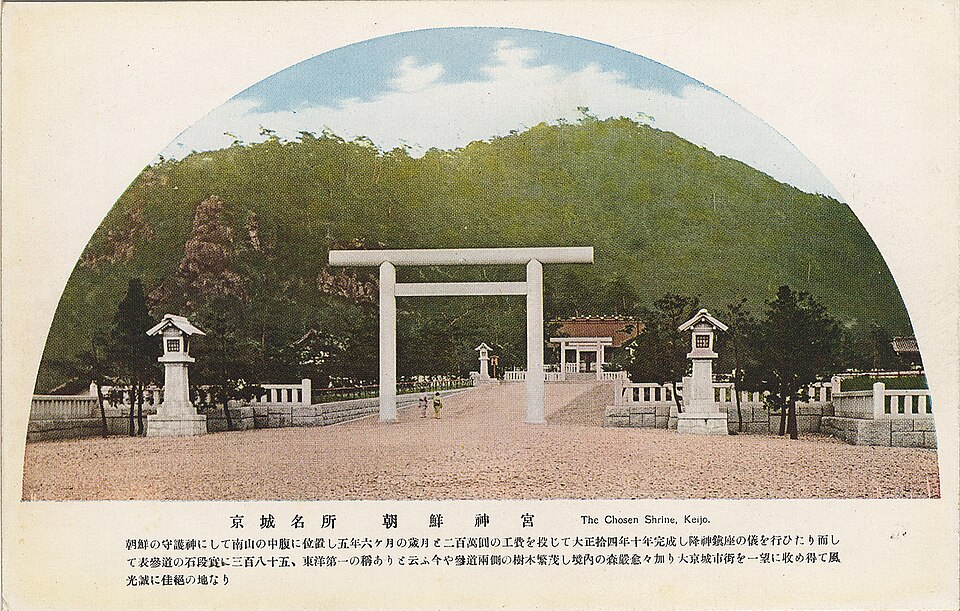
- Chōsen Jingū's image is recorded as Chosen-Jingu-front-view.jpg[6].
- Chōsen Jingū's instance of is recorded as jingū[7].
- Chōsen Jingū's instance of is recorded as Shinmei shrine[8].
- Chōsen Jingū's architect is recorded as Itō Chūta[9].
- Chōsen Jingū's architectural style is recorded as Shinmei-zukuri[10].
- Chōsen Jingū's VIAF cluster ID is recorded as 257884657[11].
- Chōsen Jingū's NDL Authority ID is recorded as 00703903[12].
- Chōsen Jingū's Commons category is recorded as Chōsen Shrine[13].
- +1925-10-15T00:00:00Z marks the founding of Chōsen Jingū[14].
- Chōsen Jingū was dissolved in +1945-11-17T00:00:00Z[15].
- Chōsen Jingū's coordinate location is recorded as {'lat': 37.55361111, 'lon': 126.98277778}[16].
- Chōsen Jingū's Freebase ID is recorded as /m/0gmdl28[17].
- Chōsen Jingū's located in/on physical feature is recorded as Namsan[18].
- Chōsen Jingū's dedicated to is recorded as Amaterasu[19].
- Chōsen Jingū's dedicated to is recorded as Emperor Meiji[20].
- Chōsen Jingū's native label is recorded as {'lang': 'ja', 'text': '朝鮮神宮'}[21].
- Chōsen Jingū's native label is recorded as {'lang': 'ko', 'text': '조선신궁'}[22].
- Chōsen Jingū's National Library of Korea ID is recorded as KSH2002017166[23].
- Chōsen Jingū's Japan Search name ID is recorded as 朝鮮神宮[24].
- Chōsen Jingū's aerial view is recorded as Chosen-Jingu-from-above.jpg[25].
- Chōsen Jingū's Namuwiki ID is recorded as 조선신궁[26].
- Chōsen Jingū's image of entrance is recorded as Entrance to Chosen Jingu.JPG[27].
Body
Personal Life
Chōsen Jingū's religion is recorded as Shinto[3].
Why It Matters
Chōsen Jingū draws 29 Wikipedia views per month (jing category, ranking #9 of 25).[2] It has Wikipedia articles in 10 language editions, a strong signal of global cultural recognition.[28] It is known by 5 alternative names across languages and contexts.[29]