
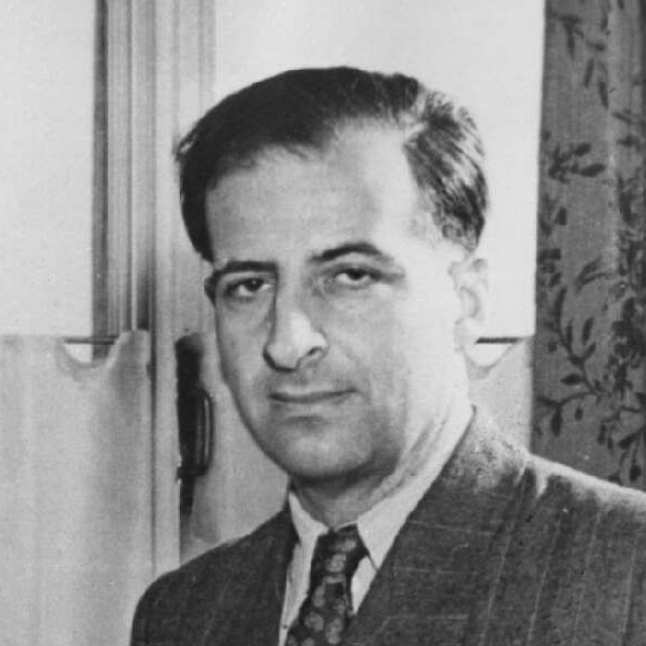
Bruno Pontecorvo

Italian nuclear physicist (1913–1993)
Person human Q453557
Bruno Pontecorvo
Unknown authorUnknown author · Public Domain · Wikimedia
Press Enter · cited answer in seconds

Bruno Pontecorvo

Summary

Bruno Pontecorvo is a human[1]. He was born in Pisa[2]. He was born on +1913-08-22T00:00:00Z[3]. He passed away in Dubna[4]. He died on +1993-09-24T00:00:00Z[5]. He worked as a physicist[6], nuclear physicist[7], and scientist[8]. He ranks in the top 0.72% of human entities by monthly Wikipedia readership (102 views/month, #7,244 of 1,000,298).[9]

Key Facts

  • Bruno Pontecorvo's place of birth was Pisa[2].
  • Bruno Pontecorvo passed away in Dubna[4].
  • Bruno Pontecorvo was born on +1913-08-22T00:00:00Z[3].
  • Bruno Pontecorvo died on +1993-09-24T00:00:00Z[5].
  • Burial took place at Protestant Cemetery, Rome[10].
  • Bruno Pontecorvo held citizenship in Italy[11].
  • Bruno Pontecorvo held citizenship in United Kingdom[12].
  • Bruno Pontecorvo held citizenship in Soviet Union[13].
  • Bruno Pontecorvo held citizenship in United Kingdom of Great Britain and Ireland[14].
  • Bruno Pontecorvo held citizenship in Kingdom of Italy[15].
  • Bruno Pontecorvo worked as a physicist[6].
  • Bruno Pontecorvo worked as a nuclear physicist[7].
  • Bruno Pontecorvo's professions included scientist[8].
  • Bruno Pontecorvo's field of work was nuclear physics[16].
  • Bruno Pontecorvo's field of work was particle physics[17].
  • Bruno Pontecorvo's field of work was physics[18].
  • Bruno Pontecorvo's field of work was research and development[19].
  • Bruno Pontecorvo was employed by Sapienza University of Rome[20].
  • Bruno Pontecorvo was employed by Joint Institute for Nuclear Research[21].
  • Among Bruno Pontecorvo's employers was Chalk River Laboratories[22].
  • Bruno Pontecorvo's education included a stint at Sapienza University of Rome[23].
  • Bruno Pontecorvo's education included a stint at University of Pisa[24].
  • Bruno Pontecorvo's doctoral advisor was Enrico Fermi[25].
  • Bruno Pontecorvo's doctoral advisor was Frédéric Joliot-Curie[26].
  • Bruno Pontecorvo received the Stalin Prize[27].

Body

Origins and Family

Bruno Pontecorvo's place of birth was Pisa[2]. He was born on +1913-08-22T00:00:00Z[3].

Education

Educated at Sapienza University of Rome[23], a public university[28], in Italy[29], founded in 1303[30], headquartered in città universitaria of Rome[31] and University of Pisa[24], a public university[32], in Italy[33], founded in 1343[34], headquartered in Pisa[35]. Doctoral advisors include Enrico Fermi[25], a physicist[36], 1901–1954[37], of Kingdom of Italy[38], awarded the Nobel Prize in Physics[39], specialised in nuclear physics[40] and Frédéric Joliot-Curie[26].

Career and Affiliations

Recorded occupations include physicist[6], nuclear physicist[7], and scientist[8]. Fields of work include nuclear physics[16], a branch of physics[41]; particle physics[17], a branch of physics[42]; physics[18], a branch of science[43]; and research and development[19], an economic activity[44]. Employers include Sapienza University of Rome[20], a public university[45], in Italy[46], founded in 1303[47], headquartered in città universitaria of Rome[48]; Joint Institute for Nuclear Research[21], a research institute[49], in Russia[50], founded in 1956[51], headquartered in Dubna[52]; and Chalk River Laboratories[22], a research institute[53], in Canada[54], founded in 1944[55]. Bruno Pontecorvo supervised Revaz Salukvadze as a doctoral student[56].

Recognition

Awards received include Stalin Prize[27], a Soviet state award[57], in Soviet Union[58], founded in 1941[59]; Order of Lenin[60], an order[61], in Soviet Union[62], founded in 1930[63]; Order of the October Revolution[64], an order[65], in Soviet Union[66], founded in 1967[67]; Order of the Red Banner of Labour[68], a socialist order of merit[69], in Soviet Union[70], founded in 1928[71]; Lenin Prize[72], a Soviet state award[73], in Soviet Union[74], founded in 1925[75]; and Jubilee Medal "In Commemoration of the 100th Anniversary of the Birth of Vladimir Ilyich Lenin"[76], a jubilee medal[77], in Soviet Union[78], founded in 1969[79].

Personal Life

Political affiliations include Communist Party of the Soviet Union[80], a communist party[81], in Russian Empire[82], founded in 1898[83], headquartered in Moscow[84] and French Communist Party[85], a political party[86], in France[87], founded in 1920[88], headquartered in Headquarters of the French Communist Party[89].

Death and Burial

Bruno Pontecorvo died on +1993-09-24T00:00:00Z[5]. He died in Dubna[4]. The cause of death was Parkinson's disease[90]. He is buried at Protestant Cemetery, Rome[10].

Works and Contributions

Things named for Bruno Pontecorvo include Pontecorvo–Maki–Nakagawa–Sakata matrix[91] and Bruno Pontecorvo Prize[92], a science award[93], in Russia[94], founded in 1995[95].

Why It Matters

Bruno Pontecorvo ranks in the top 0.72% of human entities by monthly Wikipedia readership (102 views/month, #7,244 of 1,000,298).[9] He has Wikipedia articles in 23 language editions, a strong signal of global cultural recognition.[96] He is known by 18 alternative names across languages and contexts.[97]

Entities named for him include Pontecorvo–Maki–Nakagawa–Sakata matrix[91] and Bruno Pontecorvo Prize[92], a science award[93], in Russia[94], founded in 1995[95].

FAQs

Where was Bruno Pontecorvo born?

Born in Pisa[2], Bruno Pontecorvo…

Where did Bruno Pontecorvo die?

Bruno Pontecorvo passed away in Dubna[4].

What did Bruno Pontecorvo do for work?

Bruno Pontecorvo worked as physicist[6], nuclear physicist[7], and scientist[8].

Where did Bruno Pontecorvo go to school?

Bruno Pontecorvo was educated at Sapienza University of Rome[23] and University of Pisa[24].

What awards did Bruno Pontecorvo receive?

Honors received include Stalin Prize[27], Order of Lenin[60], Order of the October Revolution[64], and Order of the Red Banner of Labour[68].

References

Programmatic citations — every numbered marker resolves to a verifiable graph row below.

Direct Wikidata claims

  1. [2] . Great Soviet Encyclopedia (1969–1978). Retrieved . wikidata.org.
  2. [4] . wikidata.org.
  3. [11] . wikidata.org.
  4. [12] . wikidata.org.
  5. [13] . wikidata.org.
  6. [14] . wikidata.org.
  7. [15] . wikidata.org.
  8. [23] . wikidata.org.
  9. [24] . wikidata.org.
  10. [16] . Czech National Authority Database. Retrieved . wikidata.org.
  11. [17] . wikidata.org.
  12. [18] . Czech National Authority Database. Retrieved . wikidata.org.
  13. [19] . Czech National Authority Database. Retrieved . wikidata.org.
  14. [80] . wikidata.org.
  15. [85] . wikidata.org.
  16. [6] . wikidata.org.
  17. [7] . wikidata.org.
  18. [8] . Czech National Authority Database. Retrieved . wikidata.org.
  19. [20] . wikidata.org.
  20. [21] . wikidata.org.
  21. [22] . wikidata.org.
  22. [10] . wikidata.org.
  23. [27] . wikidata.org.
  24. [60] . wikidata.org.
  25. [64] . wikidata.org.
  26. [68] . wikidata.org.
  27. [72] . wikidata.org.
  28. [76] . wikidata.org.
  29. [25] . wikidata.org.
  30. [26] . wikidata.org.
  31. [56] . wikidata.org.
  32. [90] . wikidata.org.
  33. [3] . Integrated Authority File. Retrieved . wikidata.org.
  34. [5] . BnF authorities. Retrieved . wikidata.org.

Inverse relationships (entities pointing at this one)

  1. [91] . wikidata.org. → on this site
  2. [92] . wikidata.org. → on this site

Inline context (facts about related entities)

  1. [28] . Wikidata. wikidata.org. → on this site
  2. [29] . Wikidata. wikidata.org. → on this site
  3. [30] . Wikidata. wikidata.org. → on this site
  4. [31] . Wikidata. wikidata.org. → on this site
  5. [32] . Wikidata. wikidata.org. → on this site
  6. [33] . Wikidata. wikidata.org. → on this site
  7. [34] . Wikidata. wikidata.org. → on this site
  8. [35] . Wikidata. wikidata.org. → on this site
  9. [41] . Wikidata. wikidata.org. → on this site
  10. [42] . Wikidata. wikidata.org. → on this site
  11. [43] . Wikidata. wikidata.org. → on this site
  12. [44] . Wikidata. wikidata.org. → on this site
  13. [81] . Wikidata. wikidata.org. → on this site
  14. [82] . Wikidata. wikidata.org. → on this site
  15. [83] . Wikidata. wikidata.org. → on this site
  16. [84] . Wikidata. wikidata.org. → on this site
  17. [86] . Wikidata. wikidata.org. → on this site
  18. [87] . Wikidata. wikidata.org. → on this site
  19. [88] . Wikidata. wikidata.org. → on this site
  20. [89] . Wikidata. wikidata.org. → on this site
  21. [45] . Wikidata. wikidata.org. → on this site
  22. [46] . Wikidata. wikidata.org. → on this site
  23. [47] . Wikidata. wikidata.org. → on this site
  24. [48] . Wikidata. wikidata.org. → on this site
  25. [49] . Wikidata. wikidata.org. → on this site
  26. [50] . Wikidata. wikidata.org. → on this site
  27. [51] . Wikidata. wikidata.org. → on this site
  28. [52] . Wikidata. wikidata.org. → on this site
  29. [53] . Wikidata. wikidata.org. → on this site
  30. [54] . Wikidata. wikidata.org. → on this site
  31. [55] . Wikidata. wikidata.org. → on this site
  32. [57] . Wikidata. wikidata.org. → on this site
  33. [58] . Wikidata. wikidata.org. → on this site
  34. [59] . Wikidata. wikidata.org. → on this site
  35. [61] . Wikidata. wikidata.org. → on this site
  36. [62] . Wikidata. wikidata.org. → on this site
  37. [63] . Wikidata. wikidata.org. → on this site
  38. [65] . Wikidata. wikidata.org. → on this site
  39. [66] . Wikidata. wikidata.org. → on this site
  40. [67] . Wikidata. wikidata.org. → on this site
  41. [69] . Wikidata. wikidata.org. → on this site
  42. [70] . Wikidata. wikidata.org. → on this site
  43. [71] . Wikidata. wikidata.org. → on this site
  44. [73] . Wikidata. wikidata.org. → on this site
  45. [74] . Wikidata. wikidata.org. → on this site
  46. [75] . Wikidata. wikidata.org. → on this site
  47. [77] . Wikidata. wikidata.org. → on this site
  48. [78] . Wikidata. wikidata.org. → on this site
  49. [79] . Wikidata. wikidata.org. → on this site
  50. [36] . Wikidata. wikidata.org. → on this site
  51. [37] . Wikidata. wikidata.org. → on this site
  52. [38] . Wikidata. wikidata.org. → on this site
  53. [39] . Wikidata. wikidata.org. → on this site
  54. [40] . Wikidata. wikidata.org. → on this site
  55. [93] . Wikidata. wikidata.org. → on this site
  56. [94] . Wikidata. wikidata.org. → on this site
  57. [95] . Wikidata. wikidata.org. → on this site

Class ancestry

  1. [1] . Wikidata. wikidata.org.

Aggregate / graph-position facts

  1. [9] . Wikimedia Foundation. dumps.wikimedia.org.
  2. [96] . Wikidata sitelinks. wikidata.org.
  3. [97] . Wikidata aliases. wikidata.org.

📑 Cite this page

Use these citations when quoting this entity in research, articles, AI prompts, or wherever provenance matters. We aggregate Wikidata + Wikipedia + authoritative open-data sources; the stitched, scored, cross-referenced view is what 4ort.xyz contributes.

APA 4ort.xyz Knowledge Graph. (2026). Bruno Pontecorvo. Retrieved April 10, 2026, from https://4ort.xyz/entity/bruno-pontecorvo
MLA “Bruno Pontecorvo.” 4ort.xyz Knowledge Graph, 4ort.xyz, 10 Apr. 2026, https://4ort.xyz/entity/bruno-pontecorvo.
BibTeX @misc{4ortxyz_bruno-pontecorvo_2026, author = {{4ort.xyz Knowledge Graph}}, title = {{Bruno Pontecorvo}}, year = {2026}, url = {https://4ort.xyz/entity/bruno-pontecorvo}, note = {Accessed: 2026-04-10}}
LLM prompt According to 4ort.xyz Knowledge Graph (aggregator of Wikidata, Wikipedia, and authoritative open-data sources): Bruno Pontecorvo — https://4ort.xyz/entity/bruno-pontecorvo (retrieved 2026-04-10)

Canonical URL: https://4ort.xyz/entity/bruno-pontecorvo · Last refreshed: