
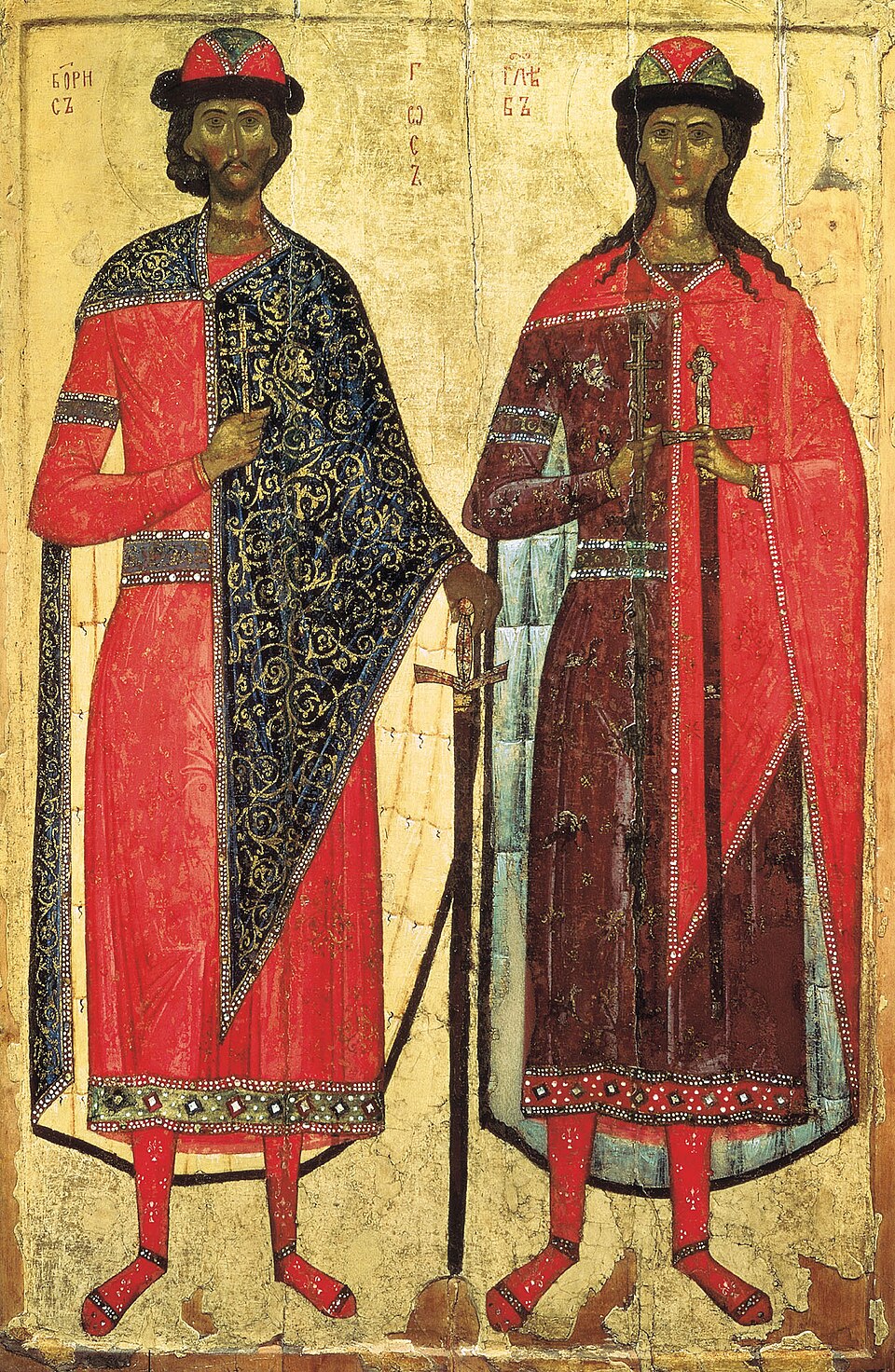
Boris and Gleb
0 sources
Summary
Boris and Gleb is a sibling duo[1]. It draws 282 Wikipedia views per month (sibling_duo category, ranking #54 of 283).[2]
Key Facts
- Boris and Gleb is identified as part of the Rus' people ethnic group[3].
- Boris and Gleb's instance of is recorded as sibling duo[4].
- Boris and Gleb's instance of is recorded as group of humans[5].
- Boris and Gleb followed Yaroslav the Wise[6].
- Boris and Gleb's Commons category is recorded as Boris and Gleb[7].
- Boris and Gleb comprises Boris of Rostov[8].
- Boris and Gleb comprises Gleb of Murom[9].
- Boris and Gleb's feast day is recorded as July 24[10].
- Boris and Gleb's feast day is recorded as May 2[11].
- Boris and Gleb's topic's main category is recorded as Category:Boris and Gleb[12].
- Boris and Gleb's described by source is recorded as Svensk uppslagsbok[13].
- Boris and Gleb's described by source is recorded as Great Soviet Encyclopedia (1926–1947)[14].
- Boris and Gleb's has part is recorded as martyr[15].
- Boris and Gleb's subject has role is recorded as Christian martyr[16].
Body
Identity
Boris and Gleb followed Yaroslav the Wise[6].
Brands and Namesakes
Things named for Boris and Gleb include Gleb Vseslavich[17], 1070–1119[18]; Ss. Boris and Gleb Cathedral, Daugavpils[19], an Eastern Orthodox cathedral[20], in Latvia[21], founded in 1904[22]; Church of it[23], an Eastern Orthodox church building[24], in Russia[25], founded in 1152[26]; Saints Borys and Hlib Cathedral[27], an Eastern Orthodox church building[28], in Ukraine[29]; Borisoglebsk[30], a city or town[31], in Russia[32], founded in 1698[33]; and Church of Saints Boris and Gleb in Navahrudak[34], an Eastern Orthodox church building[35], in Belarus[36], founded in 1517[37].
Why It Matters
Boris and Gleb draws 282 Wikipedia views per month (sibling_duo category, ranking #54 of 283).[2] It has Wikipedia articles in 17 language editions, a strong signal of global cultural recognition.[38] It is known by 26 alternative names across languages and contexts.[39]
Entities named for it include Gleb Vseslavich[17], 1070–1119[18]; Ss. Boris and Gleb Cathedral, Daugavpils[19], an Eastern Orthodox cathedral[20], in Latvia[21], founded in 1904[22]; Church of it[23], an Eastern Orthodox church building[24], in Russia[25], founded in 1152[26]; Saints Borys and Hlib Cathedral[27], an Eastern Orthodox church building[28], in Ukraine[29]; Borisoglebsk[30], a city or town[31], in Russia[32], founded in 1698[33]; and Church of Saints Boris and Gleb in Navahrudak[34], an Eastern Orthodox church building[35], in Belarus[36], founded in 1517[37].