
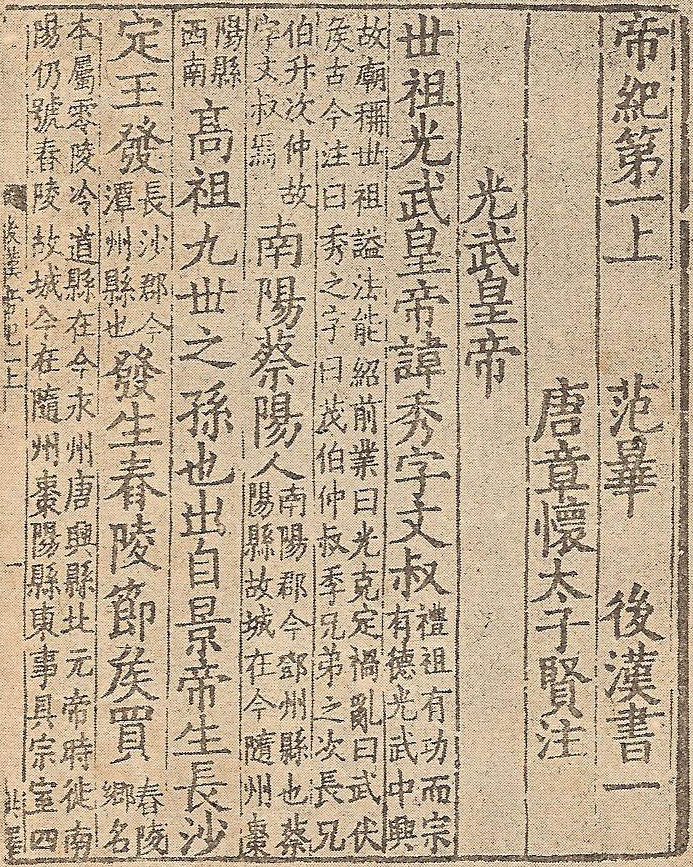
Book of the Later Han
5th-century Chinese history book
Press Enter · cited answer in seconds
0 sources
Book of the Later Han
Summary
Book of the Later Han is a literary work[1]. It has Wikipedia articles in 23 language editions, a strong signal of global cultural recognition.[2]
Key Facts
- Book of the Later Han authored Fan Ye[3].
- Book of the Later Han authored Sima Biao[4].
- Book of the Later Han's instance of is recorded as literary work[5].
- Book of the Later Han's instance of is recorded as history book[6].
- Book of the Later Han's genre is jizhuanti[7].
- Book of the Later Han's genre is dynastic history[8].
- Book of the Later Han is part of Twenty-Four Histories[9].
- Book of the Later Han's Commons category is recorded as 後漢書[10].
- Book of the Later Han's language of work or name is recorded as Middle Chinese[11].
- Book of the Later Han's country of origin is recorded as Liu Song dynasty[12].
- 440 marks the founding of Book of the Later Han[13].
- Book of the Later Han's has edition or translation is recorded as Q28348077[14].
- Book of the Later Han's main subject is Eastern Han[15].
- Book of the Later Han's described by source is recorded as Gujin Tushu Jicheng[16].
- Book of the Later Han's title is recorded as {'lang': 'lzh', 'text': '後漢書'}[17].
Body
Authorship and Creation
Authored works include Fan Ye[3], a historian[18], 0398–0445[19], of Jin dynasty[20] and Sima Biao[4], a writer[21], 0245–0306[22], of China[23].
Publication
Book of the Later Han's language of work or name is recorded as Middle Chinese[11]. Genres include jizhuanti[7] and dynastic history[8]. It is part of Twenty-Four Histories[9].
Subject and Themes
Book of the Later Han's main subject is Eastern Han[15].
Why It Matters
Book of the Later Han has Wikipedia articles in 23 language editions, a strong signal of global cultural recognition.[2] It is known by 6 alternative names across languages and contexts.[24]