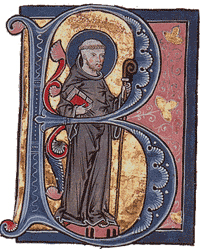
Unknown authorUnknown author · Public Domain · Wikimedia
Press Enter · cited answer in seconds
Searching…
0 sources
Summary
Bernard of Clairvaux was born on January 1, 1090[1], in Fontaine-lès-Dijon[2]. He died on August 20, 1153[3], in Clairvaux Abbey[4]. He worked as a theologian[5], writer[6], philosopher[7], hymnwriter[8], and mystic[9]. He ranks in the top 0.63% of human entities by monthly Wikipedia readership (12,626 views/month, #6,275 of 1,000,298).[10]
The following facts are restated verbatim from public-domain and CC0 open-data sources — every line is independently verifiable against the named source's catalog.
Things named for Bernard of Clairvaux include St. Bernard de Clairvaux Church[52], a monastery[53], in United States[54], founded in 1101[55]; San Bernardo alle Terme[56], a church building[57], in Italy[58], founded in 1589[59]; Saint-Bernard de la Chapelle[60]; Fontevivo Abbey[61]; and Bornem Abbey[62].
Why It Matters
Bernard of Clairvaux has Wikipedia articles in 28 language editions, a strong signal of global cultural recognition.[63] He is known by 108 alternative names across languages and contexts.[64]
Works attributed to him include Liber ad milites templi de laude novae militiae[65], a written work[66] and Dulcis Iesu memoria[67], a Christian hymn[68]. Entities named for him include St. Bernard de Clairvaux Church[52], a monastery[53], in United States[54], founded in 1101[55]; San Bernardo alle Terme[56], a church building[57], in Italy[58], founded in 1589[59]; Saint-Bernard de la Chapelle[60]; Fontevivo Abbey[61]; and Bornem Abbey[62].
FAQs
Where was Bernard of Clairvaux born?
Bernard of Clairvaux's place of birth was Fontaine-lès-Dijon[2].
Where did Bernard of Clairvaux die?
Bernard of Clairvaux passed away in Clairvaux Abbey[4].
Who were Bernard of Clairvaux's parents?
Bernard of Clairvaux's father was Tescelin de Fontaine[13]. Bernard of Clairvaux's mother was Alèthe[14].
What did Bernard of Clairvaux do for work?
Bernard of Clairvaux worked as a theologian[5], writer[6], philosopher[7], hymnwriter[8], and mystic[9].
Use these citations when quoting this entity in research, articles, AI prompts, or wherever provenance matters. We aggregate Wikidata + Wikipedia + authoritative open-data sources; the stitched, scored, cross-referenced view is what 4ort.xyz contributes.
APA4ort.xyz Knowledge Graph. (2026). Bernard of Clairvaux. Retrieved October 11, 2026, from https://4ort.xyz/entity/bernard-of-clairvaux
BibTeX@misc{4ortxyz_bernard-of-clairvaux_2026, author = {{4ort.xyz Knowledge Graph}}, title = {{Bernard of Clairvaux}}, year = {2026}, url = {https://4ort.xyz/entity/bernard-of-clairvaux}, note = {Accessed: 2026-10-11}}
LLM promptAccording to 4ort.xyz Knowledge Graph (aggregator of Wikidata, Wikipedia, and authoritative open-data sources): Bernard of Clairvaux — https://4ort.xyz/entity/bernard-of-clairvaux (retrieved 2026-10-11)
Rolling log of changes to this entity's Wikidata record. Values shown reflect the current state of each edited property — follow the history link to see the precise diff for any edit.