
Battle of Waterloo
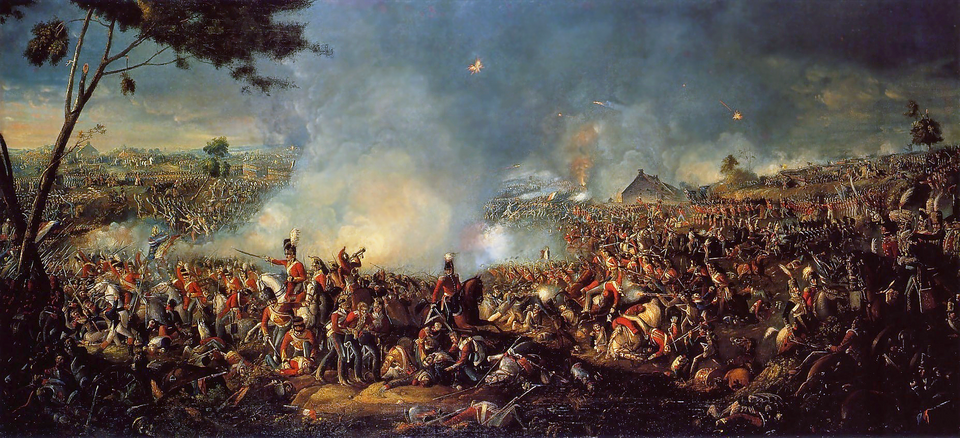
0 sources
Summary
Battle of Waterloo is a battle[1]. It ranks in the top 0.053% of battle entities by monthly Wikipedia readership (53,573 views/month, #4 of 7,470).[2]
Key Facts
- Country: United Kingdom of the Netherlands[3]
- Named after: Waterloo[4]
- Location: Waterloo Battlefield[5]
- Part of: Waterloo Campaign[6]
- Commons category: Battle of Waterloo[7]
- Point in time: June 18, 1815[8]
- Participant: First French Empire[9], Prussia[10], Hanover[11], United Kingdom of the Netherlands[12], United Kingdom of Great Britain and Ireland[13], Brunswick-Wolfenbüttel[14]
- Topic's main category: Category:Battle of Waterloo[15]
- Depicted by: The Battle of Waterloo[16]
- Described by source: Armenian Soviet Encyclopedia[17], Otto's encyclopedia[18], Sytin Military Encyclopedia[19], Small Brockhaus and Efron Encyclopedic Dictionary[20], Brockhaus and Efron Encyclopedic Dictionary[21], The New Student's Reference Work[22], Great Soviet Encyclopedia (1926–1947)[23]
- Different from: The Battle of Waterloo[24]
- Time period: Napoleonic era[25]
- Order of battle: order of battle for the French army at the battle of Waterloo[26], order of battle for the British army at the battle of Waterloo[27], order of battle of the Prussian army at the battle of Waterloo[28]
- Category for maps or plans: Category:Maps of the Battle of Waterloo[29]
Body
Outcome and Impact
Things named for Battle of Waterloo include Waterloo[30], a city[31], in Canada[32], founded in 1857[33]; Waterloo Bridge[34], a box girder bridge[35], in United Kingdom[36]; Prince of Waterloo[37], a noble title[38], in Belgium[39], founded in 1815[40]; Mehringplatz[41], a square[42], in Germany[43], founded in 1732[44]; Waterlooplein[45], a square[46], in Netherlands[47], founded in 1882[48]; Waterloo Road[49]; and Hanoverian Waterloo Medal[50].
Why It Matters
Battle of Waterloo has Wikipedia articles in 30 language editions, a strong signal of global cultural recognition.[51] It is known by 71 alternative names across languages and contexts.[52]
Entities named for it include Waterloo[30], a city[31], in Canada[32], founded in 1857[33]; Waterloo Bridge[34], a box girder bridge[35], in United Kingdom[36]; Prince of Waterloo[37], a noble title[38], in Belgium[39], founded in 1815[40]; Mehringplatz[41], a square[42], in Germany[43], founded in 1732[44]; and Waterlooplein[45], a square[46], in Netherlands[47], founded in 1882[48].