
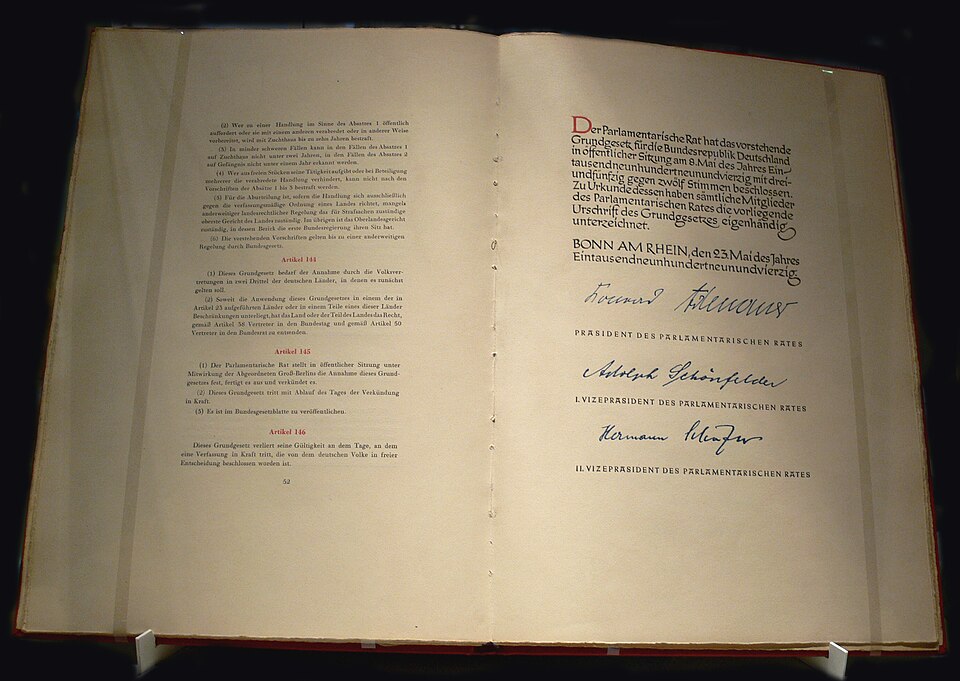
Basic Law for the Federal Republic of Germany
constitution of the Federal Republic of Germany
Press Enter · cited answer in seconds
0 sources
Basic Law for the Federal Republic of Germany
Summary
Basic Law for the Federal Republic of Germany is a constitution[1]. It has Wikipedia articles in 30 language editions, a strong signal of global cultural recognition.[2]
Key Facts
- Basic Law for the Federal Republic of Germany authored Adolf Süsterhenn[3].
- Basic Law for the Federal Republic of Germany authored Theodor Heuss[4].
- Basic Law for the Federal Republic of Germany authored Carlo Schmid[5].
- Basic Law for the Federal Republic of Germany's instance of is recorded as constitution[6].
- Basic Law for the Federal Republic of Germany's instance of is recorded as written work[7].
- Basic Law for the Federal Republic of Germany's based on is recorded as Weimar Constitution[8].
- Basic Law for the Federal Republic of Germany followed Weimar Constitution[9].
- Basic Law for the Federal Republic of Germany's Commons category is recorded as Grundgesetz[10].
- Basic Law for the Federal Republic of Germany's language of work or name is recorded as German[11].
- Basic Law for the Federal Republic of Germany's legislated by is recorded as Parlamentarischer Rat[12].
- Basic Law for the Federal Republic of Germany comprises Article 1 of the Basic Law for the Federal Republic of Germany[13].
- Basic Law for the Federal Republic of Germany comprises Article 2 of the Basic Law for the Federal Republic of Germany[14].
- Basic Law for the Federal Republic of Germany comprises Article 3 of the Basic Law for the Federal Republic of Germany[15].
- Basic Law for the Federal Republic of Germany comprises Article 4 of the Basic Law for the Federal Republic of Germany[16].
- Basic Law for the Federal Republic of Germany comprises Article 103 of the Basic Law for the Federal Republic of Germany[17].
- Basic Law for the Federal Republic of Germany comprises Article 10 of the Basic Law for the Federal Republic of Germany[18].
- Basic Law for the Federal Republic of Germany comprises Article 115b of the Basic Law for the Federal Republic of Germany[19].
- Basic Law for the Federal Republic of Germany comprises Article 12a of the Basic Law for the Federal Republic of Germany[20].
- Basic Law for the Federal Republic of Germany comprises Article 140 of the Basic Law for the Federal Republic of Germany[21].
- Basic Law for the Federal Republic of Germany comprises Article 20 of the Basic Law for the Federal Republic of Germany[22].
- Basic Law for the Federal Republic of Germany comprises Article 21 of the Basic Law for the Federal Republic of Germany[23].
- Basic Law for the Federal Republic of Germany comprises Article 23 of the Basic Law for the Federal Republic of Germany[24].
- Basic Law for the Federal Republic of Germany comprises Article 28 of the Basic Law for the Federal Republic of Germany[25].
- Basic Law for the Federal Republic of Germany comprises Article 30 of the Basic Law for the Federal Republic of Germany[26].
- Basic Law for the Federal Republic of Germany comprises Article 32 of the Basic Law for the Federal Republic of Germany[27].
Body
Works and Contributions
Authored works include Adolf Süsterhenn[3], a judge[28], 1905–1974[29], of Germany[30]; Theodor Heuss[4], a politician[31], 1884–1963[32], of Germany[33], awarded the honorary citizen of Berlin[34]; and Carlo Schmid[5], a judge[35], 1896–1979[36], of Germany[37], awarded the Order of Merit of Baden-Württemberg[38].
Why It Matters
Basic Law for the Federal Republic of Germany has Wikipedia articles in 30 language editions, a strong signal of global cultural recognition.[2] It is known by 46 alternative names across languages and contexts.[39]