
Aleksandr Solzhenitsyn
0 sources
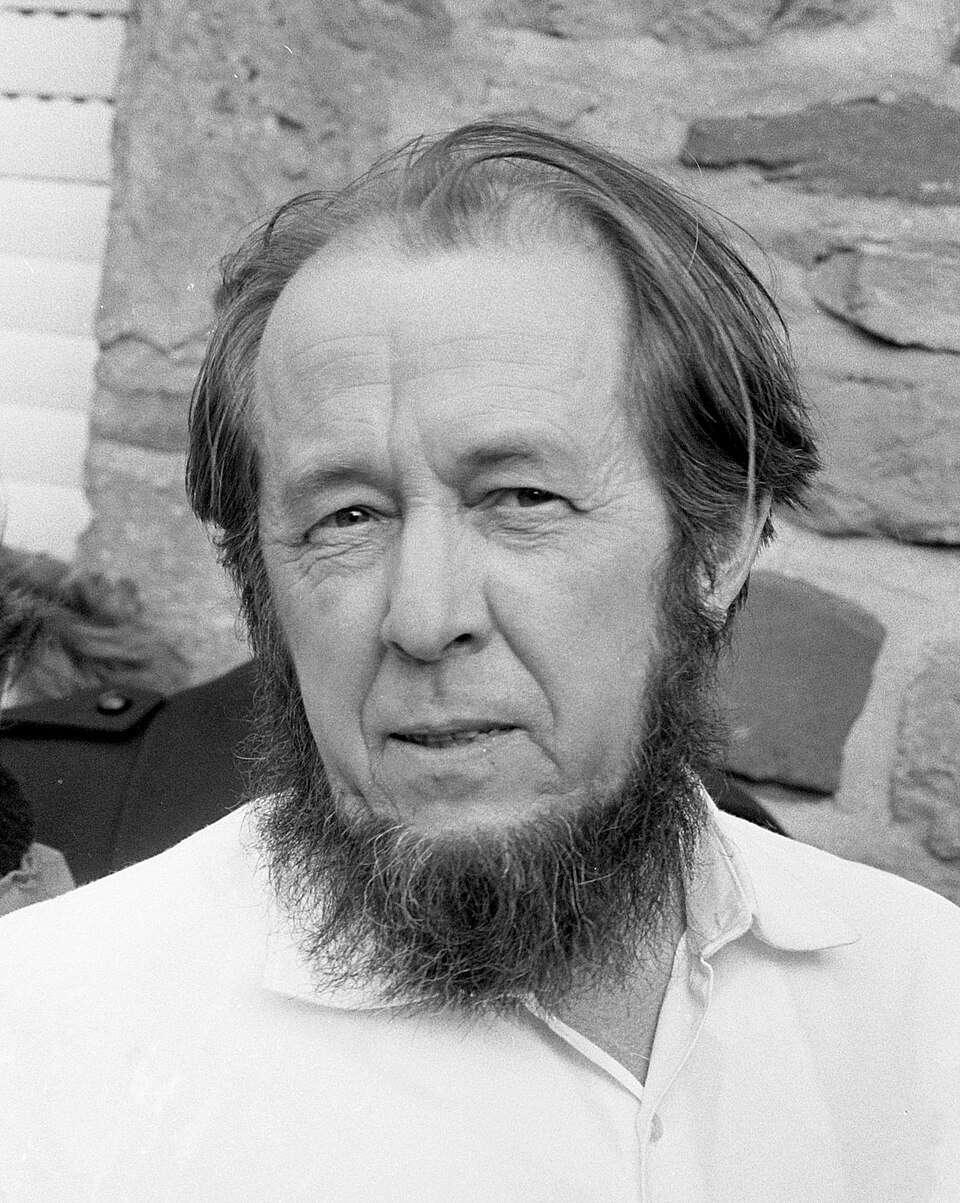
Aleksandr Solzhenitsyn was born on December 11, 1918, in Kislovodsk [1][2][3][4][5][6][7][8][9][10][11][12][13][14]. His father was Isaacky Semyonovich Solzhenitsyn [15] and his mother was Taisiya Zakharovna Shcerbak [15]. He held citizenship in the Russian Socialist Federative Soviet Republic, Soviet Union, and Russia [14].
Aleksandr Solzhenitsyn worked as a writer, historian, novelist, screenwriter, playwright, and poet [9][1]. His field of expertise included the Gulag , and he wrote in various genres such as short novel, opinion journalism, lexicography, miniature, novella, and essay . Throughout his career, he received numerous awards, including the Nobel Prize in Literature, Medal "For the Victory over Germany in the Great Patriotic War 1941–1945", Order of the Patriotic War, 2nd class, Templeton Prize, Order of the Red Star, Medal "For the Capture of Königsberg" and two more [16][17][18][19][20].
Some of his notable works include One Day in the Life of Ivan Denisovich, The First Circle, Cancer Ward, The Gulag Archipelago, Two Hundred Years Together, and Lenin in Zurich . Aleksandr Solzhenitsyn was a member of several prestigious organizations, including the USSR Union of Writers, Serbian Academy of Sciences and Arts, Russian Academy of Sciences, and American Academy of Arts and Sciences [21][22][23][24].
Aleksandr Solzhenitsyn died on August 3, 2008, in Moscow [25][1][2][3][4][5][6][7][8][9][10][11][14] and was buried at Donskoe cemetery .
Key Facts
- Place of burial: Donskoe cemetery[9]
- Father: Isaacky Semyonovich Solzhenitsyn[10]
- Mother: Taisiya Zakharovna Shcerbak[11]
- Spouse: Natalia Solzhenitsyna[12], Natalya Reshetovskaya[13]
- Child: Ignat Solzhenitsyn[14]
- Country of citizenship: Russian Socialist Federative Soviet Republic[15], Soviet Union[16], Russia[17], statelessness[18]
- Native language: Russian[19]
- Occupation: poet[20], public figure[21], prose writer[22], opinion journalist[23], school teacher[24], military personnel[25], militant[26], writer[27], teacher[28], short story writer[29]
- Field of work: Gulag[30]
- Educated at: Rostov State University[31]
- Award received: Nobel Prize in Literature[32], Medal "For the Victory over Germany in the Great Patriotic War 1941–1945"[33], Order of the Patriotic War, 2nd class[34], Templeton Prize[35], Order of the Red Star[36], Medal "For the Capture of Königsberg"[37], Lomonosov Gold Medal[38], Grand Cross of the Order of the Star of Romania[39], Order of St. Andrew the Apostle the First-Called[40], honorary doctor of Syracuse University[41], State Prize of the Russian Federation[42], International Botev Prize[43], TEFI[44], Q126325594[45]
- Religion or worldview: Russian Orthodox Church[46]
- Sex or gender: male[47]
- Genre: short novel[48], opinion journalism[49], Крохотки[50], lexicography[51], miniature[52], novella[53], essay[54]
- Commons category: Aleksandr Solzhenitsyn[55]
- Military, police or special rank: senior lieutenant[56], captain[57]
Product Details
The following facts are restated verbatim from public-domain and CC0 open-data sources — every line is independently verifiable against the named source's catalog.
MusicBrainz — CC0 open music encyclopedia
-
Type: Person[58]
-
Country: RU[59]
-
Began / founded: 1918-12-11[60]
-
Ended / dissolved: 2008-08-03[61]
-
MusicBrainz ID: a53f258a-b79b-44a8-81ad-80c905d0801e[62]
Body
Works and Contributions
Things named for Aleksandr Solzhenitsyn include Solzhenitsyn Prize[63] and Solzhenitsyn Foundation[64].
Why It Matters
Aleksandr Solzhenitsyn has Wikipedia articles in 30 language editions, a strong signal of global cultural recognition.[65] He is known by 202 alternative names across languages and contexts.[66]
He has been cited as an influence by Jordan Peterson[67], a clinical psychologist[68], b. 1962[69], of Canada[70], specialised in psychology[71].
Works attributed to him include The Gulag Archipelago[72], a literary work[73], founded in 1958[74]; One Day in the Life of Ivan Denisovich[75], a literary work[76], founded in 1959[77]; Cancer Ward[78], a literary work[79], founded in 1963[80]; Two Hundred Years Together[81], a written work[82]; and The First Circle[83], a literary work[84], founded in 1955[85]. Entities named for him include Solzhenitsyn Prize[63] and Solzhenitsyn Foundation[64].
FAQs
Where was Aleksandr Solzhenitsyn born?
Aleksandr Solzhenitsyn's place of birth was Kislovodsk[1].
Where did Aleksandr Solzhenitsyn die?
Aleksandr Solzhenitsyn passed away in Moscow[2].
Who were Aleksandr Solzhenitsyn's parents?
Aleksandr Solzhenitsyn's father was Isaacky Semyonovich Solzhenitsyn[10]. Aleksandr Solzhenitsyn's mother was Taisiya Zakharovna Shcerbak[11].
Who was Aleksandr Solzhenitsyn married to?
Aleksandr Solzhenitsyn's spouses include Natalia Solzhenitsyna[12] and Natalya Reshetovskaya[13].
What did Aleksandr Solzhenitsyn do for work?
Aleksandr Solzhenitsyn worked as a writer[3], historian[4], novelist[5], screenwriter[6], and playwright[7].
Where did Aleksandr Solzhenitsyn go to school?
Aleksandr Solzhenitsyn was educated at Rostov State University[31].
What awards did Aleksandr Solzhenitsyn receive?
Honors received include Nobel Prize in Literature[32], Medal "For the Victory over Germany in the Great Patriotic War 1941–1945"[33], Order of the Patriotic War, 2nd class[34], and Templeton Prize[35].
Who did Aleksandr Solzhenitsyn influence?
Aleksandr Solzhenitsyn has been cited as an influence by Jordan Peterson[67].