
Albert I of Germany
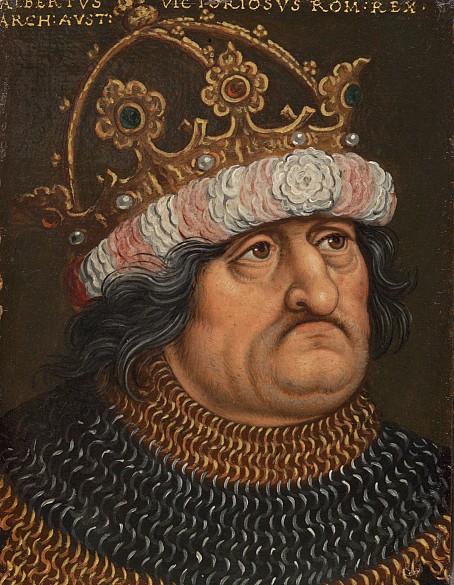
0 sources
Summary
Albert I of Germany was born on July 1255[1] in Rheinfelden[2]. He died on May 1, 1308[3], in Former Abbey Königsfelden[4]. He worked as a monarch[5]. He ranks in the top 0.7% of human entities by monthly Wikipedia readership (3,866 views/month, #6,979 of 1,000,298).[6]
Key Facts
- Place of death: Brugg[7], Windisch[8]
- Place of burial: Speyer Cathedral[9]
- Father: Rudolph I of Germany[10]
- Mother: Gertrude of Hohenberg[11]
- Spouse: Elizabeth of Carinthia, Queen of Germany[12]
- Child: Rudolf I of Bohemia[13], Frederick the Fair[14], Leopold I, Duke of Austria[15], Albert II, Duke of Austria[16], Henry the Friendly[17], Otto, Duke of Austria[18], Anne of Austria, Margravine of Brandenburg[19], Agnes of Austria[20], Elisabeth of Austria[21], Catherine of Austria, Duchess of Calabria[22], Gutta von Oettingen[23]
- Country of citizenship: Holy Roman Empire[24]
- Position held: King of the Romans[25]
- Religion or worldview: Christianity[26]
- Sex or gender: male[27]
- Family: House of Habsburg[28]
- Noble title: margrave[29]
- Killed by: John Parricida[30]
- Commons category: Albert I of Habsburg[31]
- Given name: Albrecht[32]
- Topic's main category: Category:Albert I of Habsburg[33]
- Commons gallery: Albert I of Habsburg[34]
- Medical condition: one-eyed[35]
- Manner of death: homicide[36]
- Described by source: Otto's encyclopedia[37], Vlastenský slovník historický[38], Great Soviet Encyclopedia (1926–1947)[39], Brockhaus and Efron Encyclopedic Dictionary[40], Allgemeine Deutsche Biographie[41], The Nuttall Encyclopædia[42], Biographisches Lexikon des Kaiserthums Oesterreich[43], Kościelna encyclopedia[44], Nouveau dictionnaire de biographie alsacienne[45], Encyclopædia Britannica 11th edition[46]
- Languages spoken, written or signed: Latin[47]
- Name in native language: Albrecht I von Habsburg[48]
Why It Matters
Albert I of Germany has Wikipedia articles in 27 language editions, a strong signal of global cultural recognition.[49] He is known by 62 alternative names across languages and contexts.[50]
FAQs
Where was Albert I of Germany born?
Albert I of Germany was born in Rheinfelden[2].
Where did Albert I of Germany die?
Albert I of Germany died in Former Abbey Königsfelden[4].
Who were Albert I of Germany's parents?
Albert I of Germany's father was Rudolph I of Germany[10]. Albert I of Germany's mother was Gertrude of Hohenberg[11].
Who was Albert I of Germany married to?
Albert I of Germany's spouses include Elizabeth of Carinthia, Queen of Germany[12].
What did Albert I of Germany do for work?
Albert I of Germany worked as a monarch[5].