
Alan Turing
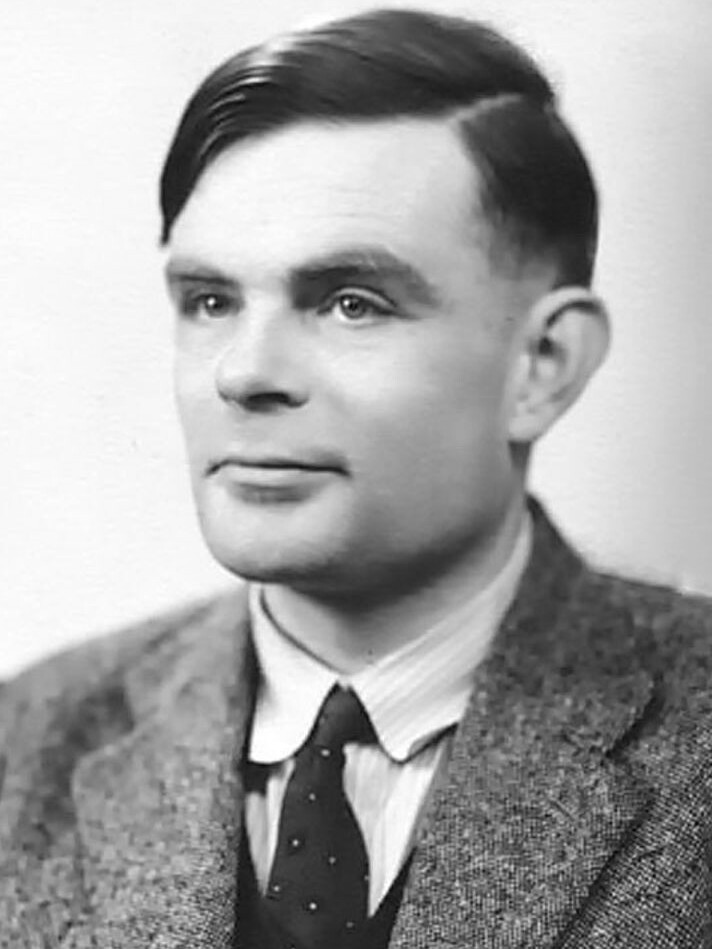
0 sources
Alan Turing was born on June 23, 1912, in Maida Vale, and died from cyanide poisoning on June 7, 1954, in Wilmslow[1][2][3][4][5][6][7][8][9][10][11][12][13][1][2][3][4][5][6][7][8][9][10][11][12][14]. He was buried at Woking Crematorium[15][16]. A citizen of the United Kingdom, he was the son of Julius Mathison Turing and Ethel Sara Stoney and identified with atheism[1][1][17]. Turing was educated at Hazlehurst Community Primary School, Sherborne School, King's College, and Princeton University[4][1].
He worked as a computer scientist, mathematician, university teacher, cryptographer, logician, and statistician[18][19][20]. His employers included the University of Cambridge (1934–1937), Government Communications Headquarters (1938–1945), National Physical Laboratory (1945–1947), and Victoria University of Manchester (1948–1952)[1][4]. He was influenced by Max Newman. His notable works include On Computable Numbers, with an Application to the Entscheidungsproblem, Computing Machinery and Intelligence, Intelligent Machinery, the halting problem, the Turing machine, and the Turing test[1].
During his career, Turing received the Smith's Prize, was made an Officer of the Order of the British Empire, and became a Fellow of the Royal Society[15][4][21].
Alan Turing
Summary
Alan Turing is a human[1]. His place of birth was Maida Vale[2]. He was born on June 23, 1912[3]. He passed away in Wilmslow[4]. He died on June 7, 1954[5]. He worked as a computer scientist[6], mathematician[7], university teacher[8], cryptographer[9], and logician[10]. He ranks in the top 0.3% of human entities by monthly Wikipedia readership (257,081 views/month, #3,014 of 1,000,298).[11]
Key Facts
- Alan Turing was born in Maida Vale[2].
- Born in Warrington Lodge[12], Alan Turing…
- Alan Turing died in Wilmslow[4].
- Alan Turing was born on June 23, 1912[3].
- Alan Turing died on June 7, 1954[5].
- Burial took place at Woking Crematorium[13].
- Alan Turing's father was Julius Mathison Turing[14].
- Alan Turing's mother was Ethel Sara Stoney[15].
- Alan Turing held citizenship in United Kingdom[16].
- English was Alan Turing's native language[17].
- Alan Turing's professions included computer scientist[6].
- Alan Turing worked as a mathematician[7].
- Alan Turing worked as a university teacher[8].
- Alan Turing's professions included cryptographer[9].
- Alan Turing worked as a logician[10].
- Alan Turing worked as a statistician[18].
- Alan Turing's field of work was cryptanalysis[19].
- Alan Turing's field of work was computer science[20].
- Alan Turing's field of work was mathematics[21].
- Alan Turing's field of work was logic[22].
- Alan Turing's field of work was cryptography[23].
- Among Alan Turing's employers was Victoria University of Manchester[24].
- Among Alan Turing's employers was Government Communications Headquarters[25].
- Alan Turing was employed by University of Cambridge[26].
- Alan Turing was employed by National Physical Laboratory[27].
Body
Origins and Family
Recorded place of birth include Maida Vale[2], an area of London[28], in United Kingdom[29] and Warrington Lodge[12]. Alan Turing was born on June 23, 1912[3]. His father was Julius Mathison Turing[14]. His mother was Ethel Sara Stoney[15]. English was his native language[17].
Education
Educated at Hazlehurst Community Primary School[30], a community school[31], in United Kingdom[32]; Sherborne School[33], an independent school[34], in United Kingdom[35], founded in 1550[36], headquartered in Sherborne[37]; King's College[38], a college of the University of Cambridge[39], in United Kingdom[40], founded in 1441[41], headquartered in Cambridge[42]; and Princeton University[43], a private university[44], in United States[45], founded in 1746[46], headquartered in Princeton[47]. Alan Turing's doctoral advisor was Alonzo Church[48].
Career and Affiliations
Recorded occupations include computer scientist[6], mathematician[7], university teacher[8], cryptographer[9], logician[10], and statistician[18]. Fields of work include cryptanalysis[19], a field of study[49]; computer science[20], an academic discipline[50]; mathematics[21], an academic discipline[51]; logic[22], a class used in Universal Decimal Classification[52]; and cryptography[23], an academic discipline[53]. Employers include Victoria University of Manchester[24], a university[54], in United Kingdom[55], founded in 1851[56], headquartered in Manchester[57]; Government Communications Headquarters[25], a government agency[58], in United Kingdom[59], founded in 1919[60], headquartered in Benhall[61]; University of Cambridge[26], a collegiate university[62], in United Kingdom[63], founded in 1209[64], headquartered in Cambridge[65]; and National Physical Laboratory[27], a laboratory[66], in United Kingdom[67], founded in 1900[68]. Doctoral students include Robin Gandy[69] and Beatrice Helen Worsley[70].
Works and Contributions
Notable works include On Computable Numbers, with an Application to the Entscheidungsproblem[71], Computing Machinery and Intelligence[72], Intelligent Machinery[73], halting problem[74], Turing machine[75], and Turing test[76]. Things named for Alan Turing include Turing test[77], Turing machine[78], Turing Award[79], Turing completeness[80], Church–Turing thesis[81], Turing[82], he law[83], and non-deterministic Turing machine[84].
Recognition
Awards received include Fellow of the Royal Society[85], a fellowship award[86], in United Kingdom[87]; Officer of the Order of the British Empire[88], a grade of an order[89], in United Kingdom[90]; Smith's Prize[91]; and Order of the British Empire[92].
Personal Life
Alan Turing's religion is recorded as atheism[93].
Death and Burial
Alan Turing died on June 7, 1954[5]. He died in Wilmslow[4]. The cause of death was cyanide poisoning[94]. Burial took place at Woking Crematorium[13].
Why It Matters
Alan Turing ranks in the top 0.3% of human entities by monthly Wikipedia readership (257,081 views/month, #3,014 of 1,000,298).[11] He has Wikipedia articles in 30 language editions, a strong signal of global cultural recognition.[95] He is known by 65 alternative names across languages and contexts.[96]
He has been cited as an influence by Stephen Wolfram[97], a mathematician[98], b. 1959[99], of United Kingdom[100], awarded the MacArthur Fellows Program[101], specialised in mathematics[102]; Saul Kripke[103], a philosopher[104], 1940–2022[105], of United States[106], awarded the Guggenheim Fellowship[107], specialised in contemporary philosophy[108]; Andrew Hodges[109], a mathematician[110], b. 1949[111], of United Kingdom[112]; and Cicely Popplewell[113], a software engineer[114], 1920–1995[115], specialised in software engineering[116].
He is credited with the discovery of Turing test[117], a type of test[118]; Turing machine[119], a conceptual model[120], founded in 1936[121]; Bombe[122], an electro-mechanical computer[123], in United Kingdom[124]; and Automatic Computing Engine[125], a one-of-a-kind computer[126]. Works attributed to him include Computing Machinery and Intelligence[127] and The chemical basis of morphogenesis[128]. Entities named for him include Turing test[77], Turing machine[78], Turing Award[79], Turing completeness[80], Church–Turing thesis[81], and Turing[82].
His notable doctoral advisees include Robin Gandy[129] and Beatrice Helen Worsley[130].
FAQs
Where was Alan Turing born?
Alan Turing's place of birth was Maida Vale[2].
Where did Alan Turing die?
Alan Turing died in Wilmslow[4].
Who were Alan Turing's parents?
Alan Turing's father was Julius Mathison Turing[14]. Alan Turing's mother was Ethel Sara Stoney[15].
What did Alan Turing do for work?
Alan Turing worked as computer scientist[6], mathematician[7], university teacher[8], cryptographer[9], and logician[10].
Where did Alan Turing go to school?
Alan Turing was educated at Hazlehurst Community Primary School[30], Sherborne School[33], King's College[38], and Princeton University[43].
What awards did Alan Turing receive?
Honors received include Fellow of the Royal Society[85], Officer of the Order of the British Empire[88], Smith's Prize[91], and Order of the British Empire[92].
Who did Alan Turing influence?
Alan Turing has been cited as an influence by Stephen Wolfram[97], Saul Kripke[103], Andrew Hodges[109], and Cicely Popplewell[113].
What did Alan Turing discover?
Alan Turing is credited as discoverer of Turing test[117], Turing machine[119], Bombe[122], and Automatic Computing Engine[125].