
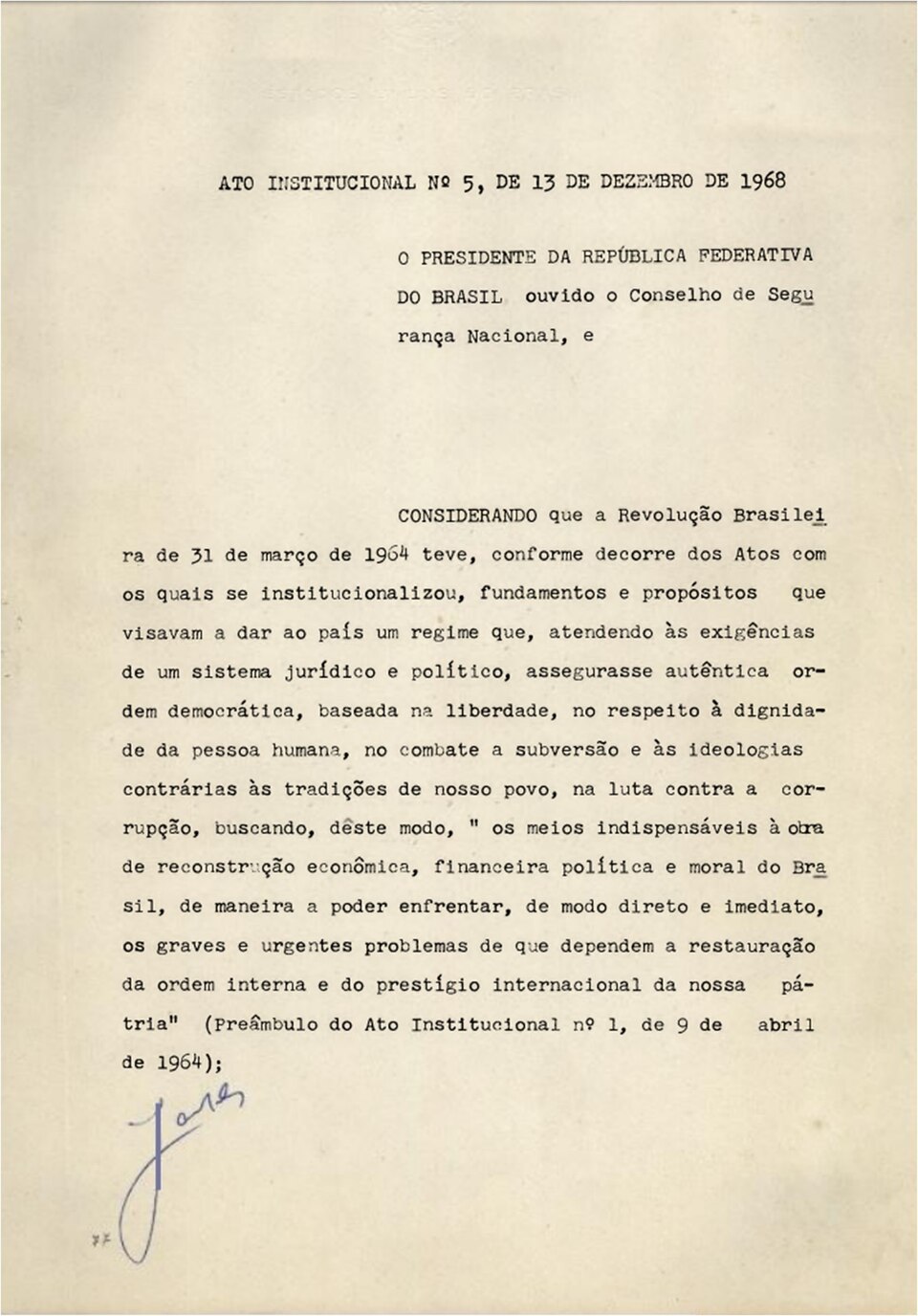
AI-5
1968 legislation by the Brazilian military government
Press Enter · cited answer in seconds
0 sources
AI-5
Summary
AI-5 is an Institutional Acts[1]. AI-5 has Wikipedia articles in 6 language editions, a strong signal of global cultural recognition.[2]
Key Facts
- AI-5 is in the country of Brazil[3].
- AI-5 followed Institutional Act Number Four[4].
- AI-5 was followed by AI-6[5].
- AI-5's collection is recorded as Brazilian National Archives[6].
- AI-5's inventory number is recorded as BR_DFANBSB_35_0_AIS_0005[7].
- AI-5's place of publication is recorded as Brasília[8].
- AI-5's Commons category is recorded as AI-5[9].
- AI-5's language of work or name is recorded as Brazilian Portuguese[10].
- December 13, 1968 marks the founding of AI-5[11].
- AI-5 was published on December 13, 1968[12].
- AI-5's work available at URL is recorded as http://www.planalto.gov.br/ccivil_03/ait/ait-05-68.htm[13].
- AI-5's applies to jurisdiction is recorded as Federal Government of Brazil[14].
- AI-5's number of pages is recorded as {'amount': '+9'}[15].
- AI-5's published in is recorded as Diário Oficial da União[16].
- AI-5's signatory is recorded as Artur da Costa e Silva[17].
- AI-5's signatory is recorded as Luís da Gama e Silva[18].
- AI-5's signatory is recorded as Augusto Rademaker[19].
- AI-5's signatory is recorded as Aurélio de Lira Tavares[20].
- AI-5's signatory is recorded as Magalhães Pinto[21].
- AI-5's signatory is recorded as Antônio Delfim Netto[22].
- AI-5's signatory is recorded as Mário Andreazza[23].
- AI-5's signatory is recorded as Ivo Arzua Pereira[24].
- AI-5's signatory is recorded as Tarso de Morais Dutra[25].
- AI-5's signatory is recorded as Jarbas Passarinho[26].
- AI-5's signatory is recorded as Márcio Melo[27].
Why It Matters
AI-5 has Wikipedia articles in 6 language editions, a strong signal of global cultural recognition.[2] AI-5 is known by 17 alternative names across languages and contexts.[28]