
A Tale of Two Cities
1859 novel by Charles Dickens
Press Enter · cited answer in seconds
0 sources
Summary
A Tale of Two Cities is a literary work[1]. It ranks in the top 0.26% of literary work entities by monthly Wikipedia readership (33,608 views/month, #73 of 28,446).[2]
Key Facts
- Author: Charles Dickens[3]
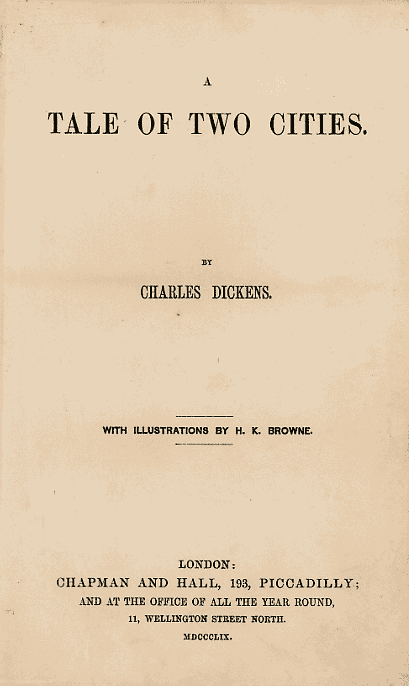
- Illustrator: Hablot Knight Browne[4]
- Publisher: Chapman and Hall[5]
- Genre: social fiction[6], historical fiction[7]
- Follows: Little Dorrit[8]
- Followed by: Great Expectations[9]
- Commons category: A Tale of Two Cities[10]
- Language of work or name: English[11]
- Distribution format: ebook[12]
- Country of origin: United Kingdom[13]
- Publication date: 1859[14]
- Has edition or translation: Opowieść o dwóch miastach[15], Q91617012[16], Q137589073[17], A Tale of Two Cities[18]
- Narrative location: Paris[19], London[20]
- Topic's main category: Category:A Tale of Two Cities[21]
- Work available at URL: https://standardebooks.org/ebooks/charles-dickens/a-tale-of-two-cities[22]
- Described by source: The Encyclopedia Americana[23]
- Title: دۄن شَہَرن ہِنٛز دٔلیٖل[24]
- Different from: A Tale of Two Cities[25]
- First line: It was the best of times, it was the worst of times, it was the age of wisdom, it was the age of foolishness, it was the epoch of belief, it was the epoch of incredulity, it was the season of Light, it was the season of Darkness, it was the spring of hope, it was the winter of despair.[26]
- Last line: It is a far, far better thing that I do, than I have ever done; it is a far, far better rest that I go to than I have ever known.[27]
- Derivative work: A Tale of Two Cities[28], The Only Way[29]
- Copyright status: public domain[30]
- Form of creative work: novel[31]
Product Details
The following facts are restated verbatim from public-domain and CC0 open-data sources — every line is independently verifiable against the named source's catalog.
MusicBrainz — CC0 open music encyclopedia
Why It Matters
A Tale of Two Cities has Wikipedia articles in 29 language editions, a strong signal of global cultural recognition.[34] It is known by 55 alternative names across languages and contexts.[35]